
In 2019 the author, faced with a dying gas boiler and failing microbore hot water central heating system, decided to explore other options. At that time heat pumps had not reached such a level of acceptance and were still viewed as somewhat experimental.
Then it was assumed, due to the ‘climate crisis’, that the price of electricity, rated per kWh, would eventually fall to the same level as gas, if not lower, so as to incentivise a move towards sustainable energy. Unfortunately that did not happen and is yet to happen. With the running cost of a heat pump only slightly less than a gas boiler, many people are simply updating their existing gas systems.
There is no doubt that heat pumps are the most efficient use of energy in most situations, but such installations are expensive, are unsuitable for some houses, and may require an entirely new system of radiators and pipework, all of which can be exceptionally disruptive. Apart from the environmentally damaging fuel of gas, the only other option is to use direct heating by electricity.
Direct heating of water by electricity, where hot water is required for a short time, such as fifteen minutes or less, is only slightly less efficient than a heat pump and needs no storage of hot water.
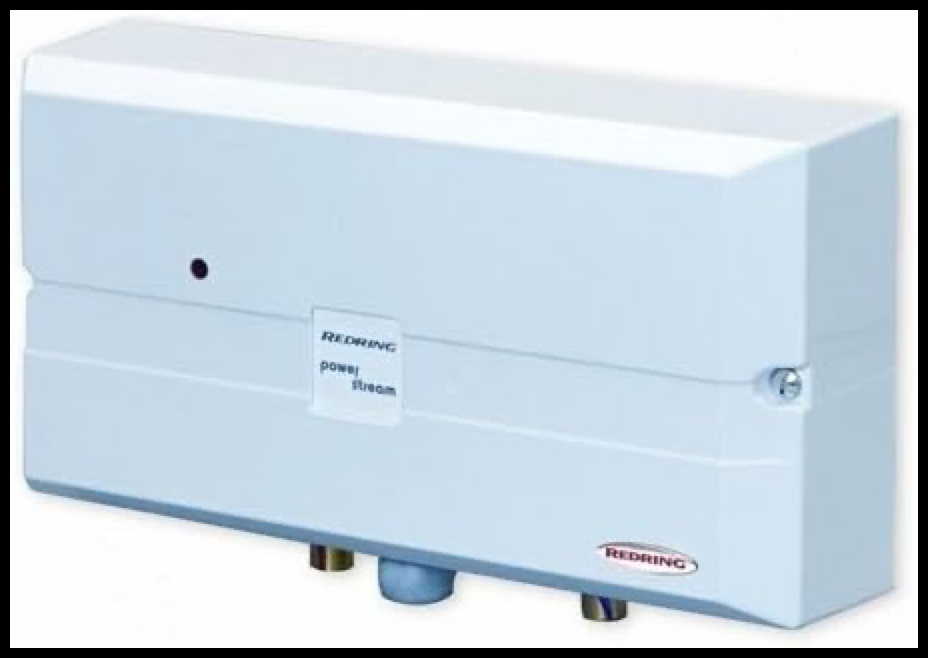
The simplest type of water heater, such as the Redring Powerstream shown below, raises the temperature of incoming water in proportion to the rate of flow through the device. Connected between the cold supply and the hot water tap, it senses any pressure difference and dispenses instant hot water when needed.
A convenient arrangement for an ‘under sink’ installation is shown below, with a pressure reduction valve, preferably of a type with an inbuilt gauge, to prevent excessive water pressure causing harm, and a pressure relief valve to release hot water should the device become overheated. Both of these extras are essential for reliable operation. The flow adjuster is set to cause the heater to switch on automatically whenever the tap is sufficiently opened.
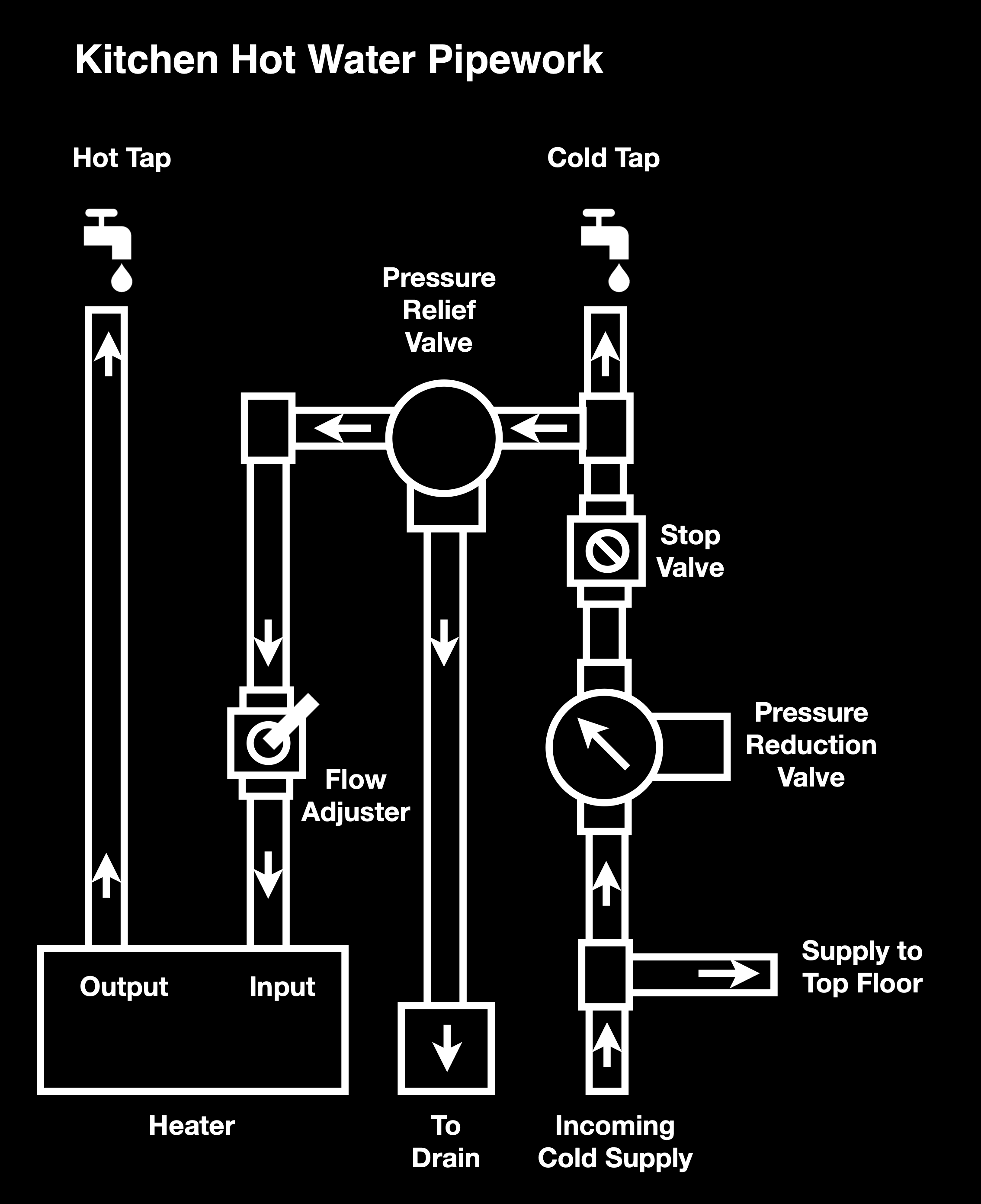
With a 12kW unit and a flow rate of 5 to six 6 litres per minute (l/m) the incoming water temperature is raised by 25 to 35C, resulting in a typical output temperature of around 30C in winter or 55C in summer. Fortunately, the temperature in winter can be increased by slowing the flow by adjusting the hot water tap.
The electrical installation must have dedicated circuit in 10mm² twin and earth cable, protected by a 5oA residual current circuit breaker with overcurrent protection (RCBO), and be provided with a double-pole isolation switch next to the heater.
A single Powerstream can also be used, as above, for both a shower and a washbasin, assuming only one is used at any given time. However, a flow rate of 6 litres per minute is insufficient for a rain shower, which needs 8 to 15 l/min at the required temperature. In this situation two units can be fitted in the attic as shown below.
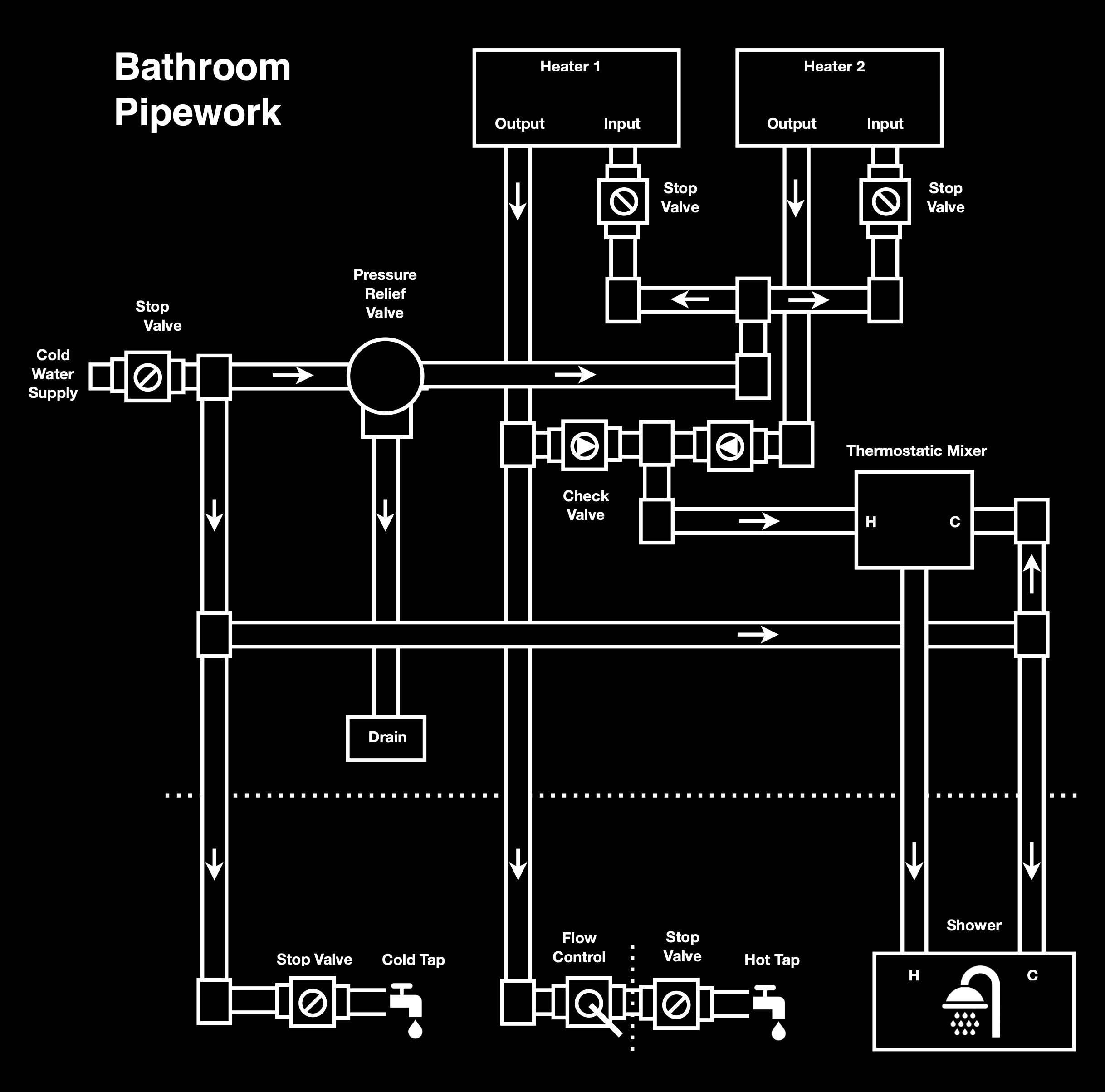
In this instance a pressure reduction valve is fitted in the basement of the building and a common pressure relief valve used. The check valves, which only allow flow in one direction, enable a single heater to be used for the tap and two for the shower. The pipework must be arranged to so that the lengths of pipe to both heaters are equal, thereby ensuring each have an exactly equal flow.
The makers of the Powerstream state quite clearly that thermostats must not be used, since this can causes the heaters to oscillate on and off, shortening their lifespan. In this instance the attic thermostat is set to a safe high temperature for showering, close to 45C, which under normal circumstances should not reduce the flow sufficiently to turn either heater off but simply adds cold water.
The thermostat on the shower is similarly set to around 45C. In normal operation it is left unchanged and the shower flow control opened fully. Once a stable temperature is reached the flow can be backed off to increase the heat, should that be required.
Note that although the total current consumption of this arrangement is 100A this will not normally be a problem, since a standard 100A house fuse is capable of carrying 140A for up to an hour without rupturing, far longer than the expected time spent in a shower.
Whilst direct heating by electricity is environmentally acceptable when using power from renewable sources, a heat pump is at least three times more efficient. Unfortunately, at the time of writing, electricity is also around three times more expensive than gas, making a heat pump is only slightly cheaper to run, whilst direct heating is three times more expensive, an iniquitous situation that fails to encourage anyone to move away from fossil fuels.
The total amount of heat required at the author’s house, based on the previous gas installation, is around 10kW, falling to around 3kW if a heat pump were used. In theory solar panels could enhance this further, but in the winter a typical 4kW installation may only provide 500W or perhaps 10kWh a day, enough for heating over three hours, better perhaps when assisted by a battery of a similar capacity. With direct heating this is reduced to just an hour.
The following diagram shows how electric Milano radiators are wired into the house.
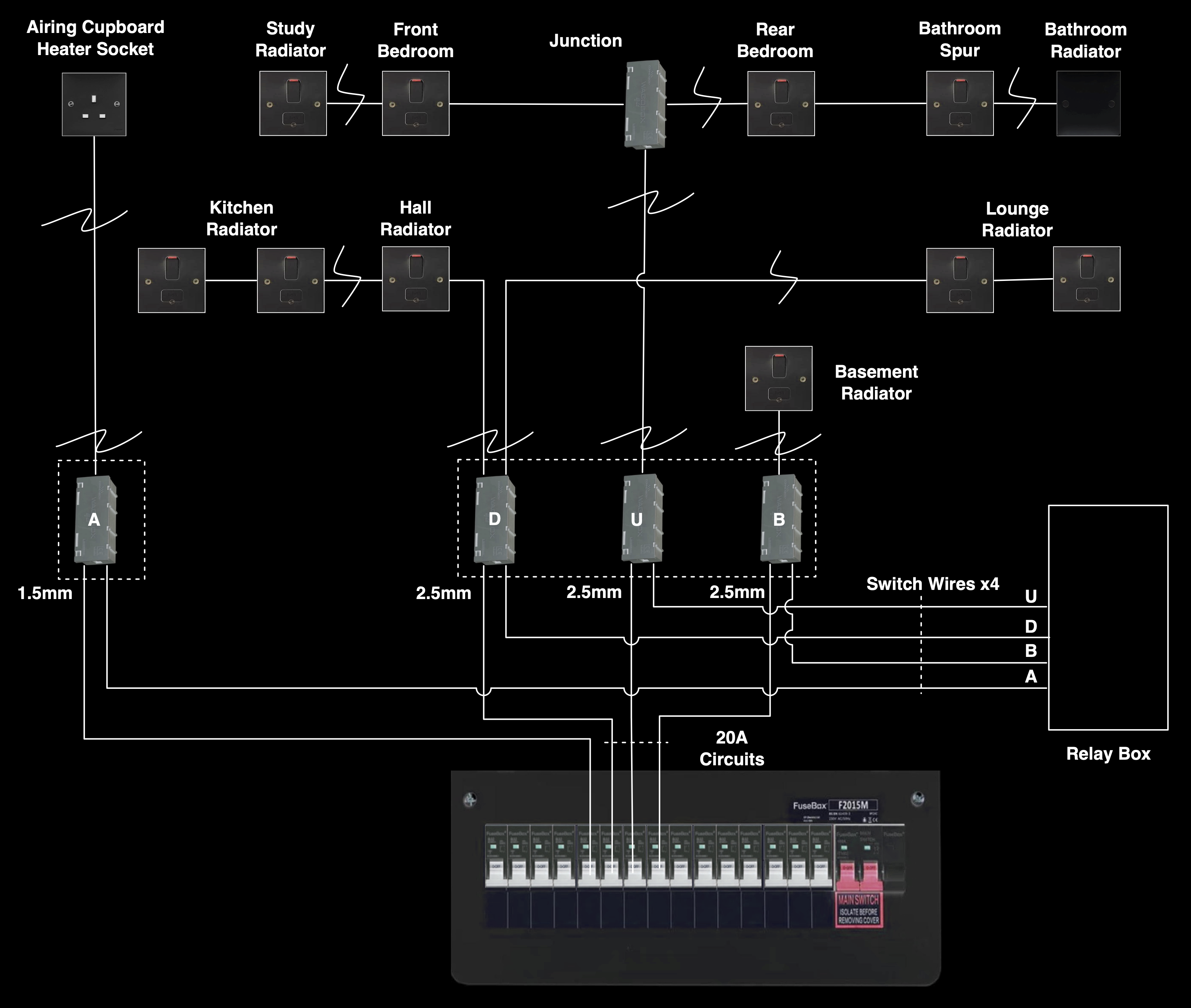
The lounge and kitchen radiators have double elements, giving an output of 1.6kW each, the bedrooms, hall and basement are rated at 1.2kW, the study at 1kW and the bathroom at 800W, providing 4.2kW of heat upstairs, 4.4kW on the first floor and 1.2kW for the basement, a grand total of 9.8kW at a cost of around £3,500.
The radiators themselves are filled with Glycol and need to be ‘bled’ when first powered. Apart from the bedroom heaters, all are left on full power, without any need to use the built-in Bluetooth features.
A relay box is used to switch two zones on and off: ‘upstairs’ for the top floor heaters and airing cupboard and ‘downstairs’ for the first floor and basement, each relay being controlled by an Eve Energy smart plug working via Matter over Thread.
Whilst direct heating for hot water is viable and avoids dependence on a centralised system, a heat pump is almost certainly a better solution for heating with low running costs, in particular for installing in new build properties and where reliability should be provided in the long term.
©Ray White 2026.